
TAT Technologies - We Anticipated the Revenue Miss, but Not the Underlying Reason
Reiterating our bullish stance

We reiterated our bullish investment thesis on TAT Technologies (TATT) for our readers last week, fully aware that the company would likely miss on Q4 2025 revenue estimates, as is par for the course. Please note that management does not provide revenue guidance, and the results show that analysts have been overly optimistic about this company’s growth.
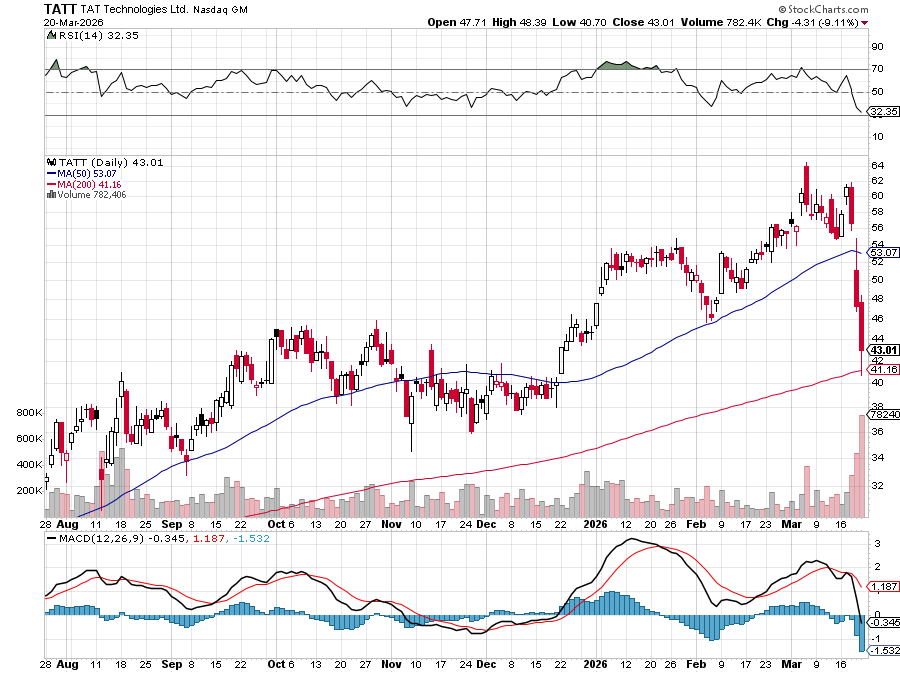
The reported Q4 2025 revenue of $46.5M missed consensus estimates by approximately $1.5M. Not much of a miss, but the stock price has declined to $43.01, down about a third from the 52-week high of $64.50.
Quick technical analyses while we are discussing the price drop, which was to support at the 200-day moving average, and fill the price gap of December. I am a firm believer in gap fills. I missed this previously, but the gap fill and the 200-day moving average are firm support, while RSI and stochastics are indicating that the price has bottomed out.
The core issue is a single Tier 1 supplier to Honeywell’s APU operations undergoing an ERP system migration, creating a certified-parts bottleneck at TATT’s Greensboro facility. This is a timing problem, not a demand problem. The APUs are physically on-site. The work orders are live. Revenue is deferred, not lost. Backlog ended Q4 at a record $550M, up $30M sequentially and $121M year-over-year. CEO Igal Zamir confirmed during the Q&A portion of last week’s earnings call that the majority of the backlog is overwhelmingly new contracts:
The vast majority of the increase comes from new contracts that were signed and OEM POs that we received for later this year. And a small portion that started showing up at the end of the year is only a small portion, if I may say, is the backlog of MRO.
The earnings call raised previously not discussed issues, which we address in this writeup such as:
Was the supply chain issue known before the report?
Why weren’t analyst estimates lowered?
Did TATT’s large inventory build actually work as intended?
Will the Honeywell Aerospace spin-off event frame the supply chain problem from a one-quarter event into a multi-quarter consideration?
Before we tackle these questions lets review the Q4 report

Revenue came in at $46.5M, representing 13.4% growth year-over-year and the company’s eighth consecutive quarter of both top-line growth and margin expansion. That streak deserves to be stated plainly before we get to the noise. The revenue composition per segment was:
Trading & Leasing revenue of $6.1M is up 84% year-over-year and 42% sequentially.
Landing Gear posted $3.3M, up 21% year-over-year.
APU came in at $13.9M, up 7% year-over-year but down 5% sequentially, which is where the supply chain story begins.
Heat Exchange was $16.6M, essentially flat year over year.
TATT continued to improve on margins. Adjusted EBITDA margin reached 14.8%, up 130 basis points. Gross margin was 25.2%
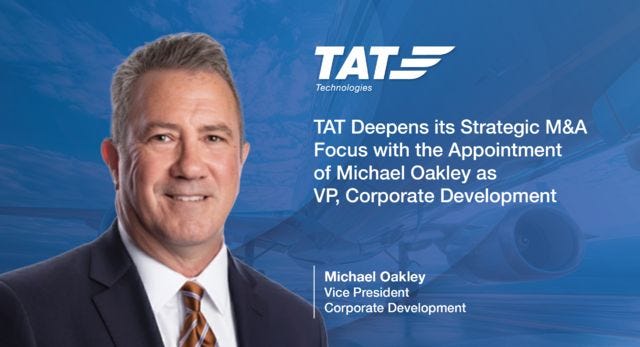
TATT exited Q4 with roughly $51.3M in cash and investments against $11.7M in debt and approximately $3.05 in net cash per diluted share. With 78% equity-to-assets and an active M&A. We did not previously mention that Michael Oakley, with over 30 years of M&A experience, was appointed in October 2025 to spearhead the company’s acquisition strategy.
(
The Supply Chain Issue

The general stress in the aerospace supply chain was well documented and publicly known long before TATT’s earnings call. The International Air Transport Association (IATA) had estimated that supply chain bottlenecks would cost the airline industry more than $11 billion in 2025. Bain & Company reported that engine overhaul turnaround times widened to 120–150 days by 2026, up from 90 days two years prior. TATT’s CEO, Zamir, had referenced supply chain headwinds throughout 2025 in prior quarters. None of this was new information.
What was not publicly known before last week’s earnings report was the specific mechanism driving the Q1 problem. A Tier 1 supplier to Honeywell’s APU operations is undergoing an ERP and logistics system migration, creating an acute certified-parts bottleneck at TATT’s Greensboro facility. That’s a company-specific event layered on top of a general industry condition.
A Stifel analyst visited the TATT Greensboro facility in early February and published a report in March, noting that he observed the facility was running at tight capacity with 60+ APUs on-site, and increased his price target to $60. This implies that the ERP appears to have intensified between the February site visit and the March earnings call.
On the earnings call, management was unambiguous about the nature of the problem: this is not a demand issue. When the parts logjam clears, and there is no structural reason it won’t, the deferred revenue will get recognized. Stifel lowered its Q1 revenue estimate to $44M. Lake Street is more conservative at $41.1M. The risk is that if this Tier 1 supplier’s ERP migration extends longer than anticipated, or if HON’s supply chain issues are broader than a single vendor, the Q1 headwind could bleed into Q2.
There is also a broader issue worth noting. Honeywell has announced plans to spin off its Aerospace division into a standalone publicly traded entity, with the separation expected to close in the second half of 2026. Major corporate restructurings of that scale have the potential to create exactly the kind of transitional supply-chain friction that TATT is currently experiencing.
Why didn’t TATT’s strategy prevent the current supply chain problem?

Management explicitly stated on the 2024 Q4 earnings call that they had strategically increased parts and rotatable inventory in areas with unstable supply chains. They acknowledged this investment had a negative effect on operational cash flow but characterized it as deliberate supply chain risk mitigation. TATT’s inventory grew from $68.5M in Q4 2024 to $75.5M in Q4 2025, and throughout 2025, the company largely executed around general parts scarcity that was crippling less-prepared competitors. The strategy worked.
The current Q1 bottleneck exposed the ceiling of that strategy. The issue is not general inventory scarcity. It is the absence of specific OEM-certified components from one approved Tier 1 vendor that TATT cannot legally substitute. This is a regulatory reality unique to aviation MRO that general inventory strategies cannot fully solve. APU repair completion requires FAA-approved, airworthiness-certified components from qualified supply chain sources. When the final certified part must come from a specific Honeywell-approved Tier 1 vendor, and that vendor’s parts flow is temporarily frozen by an ERP transition, a warehouse full of $75M in rotatable inventory cannot unblock the bottleneck. TATT cannot substitute a generic equivalent. They cannot source outside the approved supply chain. The repair sits on the floor until the certified part arrives.
This is not a management failure. It is a structural ceiling on what any inventory pre-build strategy can accomplish in an FAA-regulated MRO environment. Management built the right buffer for the right general risk. What they could not have buffered against was a specific certified supply chain chokepoint caused by a single vendor’s internal IT migration. The inventory strategy remains a competitive advantage, but not an unlimited one.
Price Target

We are maintaining our TATT position, setting a price target of $57, reflecting a modest discount to the sell-side consensus of $60 to account for supply chain duration risk and uncertainty around the HON spin-off, the latter of which is not modeled by analysts covering the name. Additionally, the 2027 analyst estimates include assumptions that the 131 program will be a revenue provider. We believe it is too early to include meaningful revenue for the nascent 131 program.
Should supply chain issues normalize in Q2 as guided, the HON spin-off transition proves smoother than feared, and one or more 131 contract announcements arrive before year-end, the consensus price target of $60 is achievable.
We will revisit our price target at Q1 results.
Risks

Readers considering TATT should weigh the following carefully.:
Supply chain duration risk. The current APU parts shortage has been characterized by management as a one-time disruption tied to a specific Tier 1 supplier’s ERP migration.
The inventory buffer has a ceiling. TATT’s deliberate inventory pre-build is a genuine competitive advantage for general supply chain disruptions. It is not a defense against FAA-certified parts chokepoints in approved supply chains where substitution is legally prohibited. Investors should understand this distinction and not assume the inventory position fully insulates TATT from further supply chain-driven revenue deferrals.
Honeywell relationship concentration and spin-off risk.
M&A execution risk. Acquisitions introduce integration risk
131 program ramp risk. The 131-series APU represents the largest addressable market opportunity in TATT’s history.
Geopolitical exposure. The Iran conflict and the associated rise in oil prices are a severe disruption to global air traffic.
Tariff and trade policy uncertainty.
Currency risk. TATT is an Israeli-domiciled company that reports in USD but operates across multiple currency environments.
Conclusion
We are maintaining our TATT position with a price target of $57. The pre-earnings caution we expressed was appropriate given the valuation and execution history, and the stock’s reaction exceeded the short-term risk we flagged due to the previously unknown supply chain logjam.
The core thesis remains intact: TATT has an eight-quarter track record of execution, a $550M backlog driven overwhelmingly by new contract wins rather than deferred revenue, a net-cash balance sheet with real M&A optionality, and a specific and temporary supply chain constraint in Q1 that management has clearly scoped and characterized as non-structural.
The risk to monitor is whether the backlog growth story holds through Q2 and Q3, whether the HON supply chain friction is truly confined to one vendor’s ERP migration or is symptomatic of something broader in the spin-off transition, and whether the 131 program produces contract announcements that validate management’s TAM expansion narrative this year. Our price target is
deliberately structured to temper unknowns, but we see a significant upside pending Q1 results/